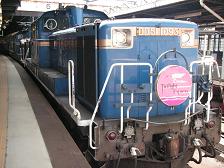
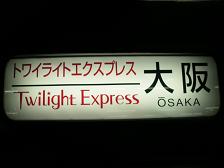
Memories of the Hokuriku Shinkansen Opening…
March 16. With the JR Group’s timetable revision, the Hokuriku Shinkansen was extended to Tsuruga.
Along with this, the conventional line between Tsuruga and Kanazawa was transferred to a third-sector operator, and the Limited Express Thunderbird, which had previously run there, now operates only as far as Tsuruga.
Speaking of the Hokuriku Main Line, I am reminded of the sleeper limited express Twilight Express, which I rode quite some time ago.
Today, I thought I would repost my account from the blog at that time.
At the time, the Hokuriku Main Line was still fully connected, so it was possible to travel by train all the way to Hokkaido via the Sea of Japan longitudinal route.
It is a fond memory now.
Please enjoy the following.
“This was a little while ago, but on June 18 and 19, 2006, we took two consecutive days off, and I took the opportunity to set off alone on an unplanned trip.
I rode the Twilight Express, a sleeper limited express connecting Osaka and Sapporo. This time, I took the northbound train from Sapporo to Kyoto.
I arrived in Sapporo by plane around noon and was soon aboard the train. At 2:05 p.m., the Twilight Express quietly departed, racing across Hokkaido in early summer as its pleasant sway and the sound of the rails echoed through the cars. In the slowly changing scenery outside the window—changing in proportion to the vastness of the land—grazing horses, small unmanned stations, and primeval forests that must have remained unchanged since ancient times appeared and disappeared, delighting the eye. Mount Usu, Showa-shinzan, Mount Komagatake, and Onuma also displayed the grandeur of Hokkaido.
In Hokkaido, so close to the summer solstice, it was still faintly light at nearly 8:00 p.m., and from the train on the Esashi Line, one could see Honshu beyond the Tsugaru Strait. Then came one of the main events of this journey: entering the Seikan Tunnel. With an especially long blast of the whistle, the scenery changed from dim twilight to darkness. Passing through a tunnel opened after many years and countless difficulties aboard such a comfortable train makes me feel a slight sense of guilt; yet I find myself thinking, rather aimlessly, that perhaps enjoying it is also a way of honoring those efforts.
Another long whistle, and we were already on the mainland. Yet the Tsugaru Peninsula, with night having fallen, was indistinguishable from the inside of the tunnel. In Aomori, the locomotive was changed, and the overnight sleeper began heading south along the Sea of Japan coast. It was already 10:00 p.m. I washed up, changed into the provided nightwear, and slipped into bed. I should mention that my lodging for the night was an inexpensive B-class private sleeper compartment. But even if it was affordable, a private compartment makes every passenger lord of their own domain—the ultimate solo journey.
Lying down with the curtains open and gazing vaguely at the dark night sky is pleasant, too. Mercury-vapor lights stream past through the darkness, and railway crossings on paths between rice fields seem to drift into view at a leisurely pace… Surrendering myself to the pleasing rhythm of the rails, I eventually fall asleep.
Cities such as Akita and Sakata, so full of life by day, are now fast asleep. I pass through these towns on a night train, rather than a night boat…
I awoke to the vibration, and when I looked outside, we were in Niitsu, Niigata. On the opposite platform stood the Moonlight Echigo, which had left Shinjuku the previous night. It was 4:30 in the morning. Summer mornings arrive early, so I converted my bed back into a sofa and decided to enjoy the second day’s views. We were due to arrive in Kyoto, my stop for the day, shortly after noon. Just thinking that I still had nearly eight hours to enjoy made me excited from the very start of the morning!
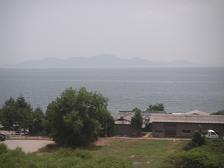
The scenery flowing past the windows of the moving train was different from that of Hokkaido. Around Toyama, the calm Sea of Japan in summer stretched out before us, sparkling with reflected morning sunlight. True to its name, the southbound Twilight Express made the setting sun sinking into the Sea of Japan the highlight of its entire journey—and took its name from that sight.
For breakfast, I chose a Japanese set meal in the dining car, Diner Pleiades. Thirty years ago, it was only natural for limited express trains to have dining cars, but now they are exceedingly rare. Being served by a smiling female cabin attendant in such a nostalgic car made the delicious meal all the more special. Back in my compartment, I finished with coffee after breakfast.
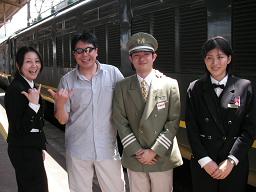
With Mount Hakusan on the left, we passed through the ancient city of Kanazawa and Fukui, the gateway to Hokuriku. At Tsuruga, the locomotive that had pulled us through the night from Aomori was replaced. I stepped down onto the platform here to take a few photographs—and snapped a few with the cabin attendants and conductor as well.
When Lake Biwa came into view, this journey was nearing its end. Somehow holding back my reluctance to leave, I stepped onto the platform in Kyoto that afternoon and watched the dark-green train set glide away toward Osaka.
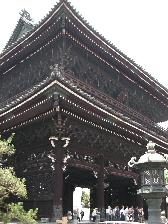
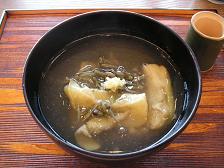
I paid my respects at Higashi Honganji, the temple of Saint Shinran, strolled around the city, and had lunch at Kyoto Isetan. I had lunch at Wakuden, a restaurant I had long admired. Its Kyoto cuisine was delicately seasoned yet full of flavor, and even at lunch it was superb. For that reason alone, getting off in Kyoto was the right choice.
The two-day break went by in no time, but it was an exceptionally rich time for me.”